

Museum Artifact: Blue Jay Bunion Plasters, c. 1910s
Made By: Bauer & Black, 2500 S. Dearborn St., Chicago, IL [Near South Side]
“Blue-jay is the wise way to treat a corn: safe, comfortable, used by millions these thirty years and more. Just a ring of velvety felt that circles the corn, ends rubbing and pressure, and eases pain instantly–while mild medication softens the corn for quick removal.” —Bauer & Black advertisement, 1930
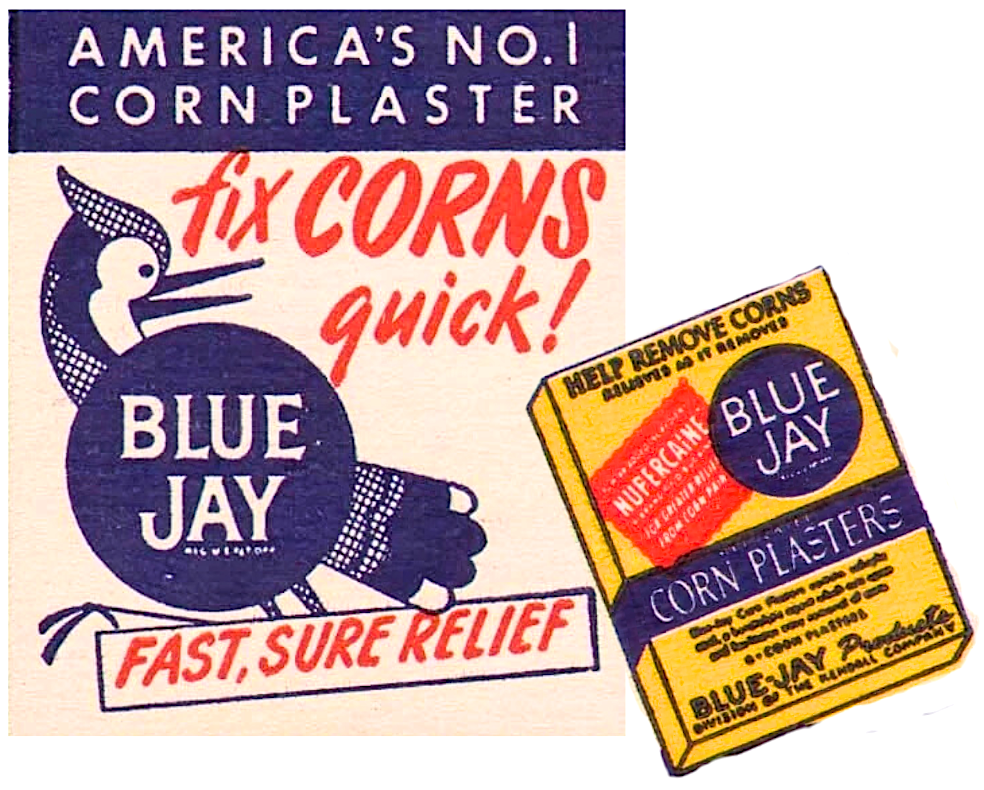 At the same time that Blue Jay corn and bunion plasters were being marketed to active, working women in magazines like Women’s World at the dawn of the 1930s, the company manufacturing them, Bauer & Black, were in the process of laying off more than half of their predominantly female workforce in Chicago.
This was not the vision anyone had in mind when Bauer & Black, a reputable maker of “surgical supplies and drug sundries,” was acquired by the similarly-minded, Massachusetts-based Kendall Company in the autumn of 1928. Less than a year after that deal, which saw the east coast outsiders take over the operation of the Chicago factory and its sales department, the US economy famously went into a complete freefall.
In the pages of a 1930 issue of Sales Management magazine, Bauer & Black’s vice president C. K. Perkins tried to paint an optimistic picture, touting how a refined and “modernized” sales plan had “ushered in a new era” for the firm.
“Even though the company had been doing a creditable volume of business and making a profit out of operations,” Perkins wrote, “it was the feeling of our executives that such a condition could not continue much longer without a more aggressive marketing program.”
Perkins and his team put a huge amount of investment into revamping how Blue Jay brand products were sold and merchandized, convincing a team of weary salesmen—still shellshocked by the sale of the company and subsequent stock market crash—to get on board with the new program or take a hike. Perkins acknowledged that the state of the economy made it impossible to know if their new strategies were actually working or not. “However, we can state,” he said, “without fear of overoptimism, that we believe the company to be in a sounder position than ever before, and that sales, within the next year or two, will set a new high.”

Katherine Hyndman: The Story of a Bauer & Black Employee
What Perkins had failed to mention in his gung-ho article is how Bauer & Black executives planned to overcome the debts their new sales program had incurred. In the early weeks of 1930, they convened a large meeting with their employees at the company’s Chicago plant, at 26th and Dearborn, to announce massive cuts in staff, to take effect immediately. Fifty percent of workers, at least, would be handed their walking papers, and no one would be shown any mercy. “Does anyone have any questions?” the new superintendent asked, as recalled by a Bauer & Black assistant forelady named Katherine Hyndman.
 “And I said to myself, ‘gosh, Kate, you’ve got a responsibility here. After all, you’re a radical’,” Hyndman continued, speaking more than forty years later in the award-winning 1976 documentary Union Maids. “You can’t let this go by and keep your mouth shut and be a coward. So, I lifted my hand, and I said, ‘I protest!’ And everybody was just shocked. I said, ‘Sir, I am opposed to this’. I said, ‘what are some of these old women going to do, who are inspectors, and have worked here for years and years? Where are they going to find another job? Even a young person can’t find a job. And what are the young women going to do? Do you want them to go down to 22nd and Wabash [the Red Light District]?”
Katherine Hyndman didn’t get any answers from the Bauer & Black superintendent, so she took more aggressive action, writing an anonymous article for a labor publication known as The Daily Worker, pointing out what was going on at the company, and calling for union organization.
“Bauer and Black, makers of surgical cotton and first aid supplies, enslave many women workers,” Hyndman wrote. “For the past few months things have been rather slack and we workers were told that things would pick up in a short time. But we see that instead of picking up things are going from bad to worse.
“Recently there was a lay-off in one of the departments and the girls that are left have to work harder than ever. Mr. Lowenstein said that after the layoff it would be better for the girls that they wouldn’t have to ‘wait’ for work and that they would make more money. He was being ‘fair’ to the girls, but he showed just how ‘fair’ he is. Right after the layoffs the dept. supervisors were called to a special meeting and there he explained to them how to make the girls turn out more work. ‘Speed’ is what he wants and we workers must supply it. As a result there is a supervisor constantly watching every move to make sure a girl doesn’t lose a minute.
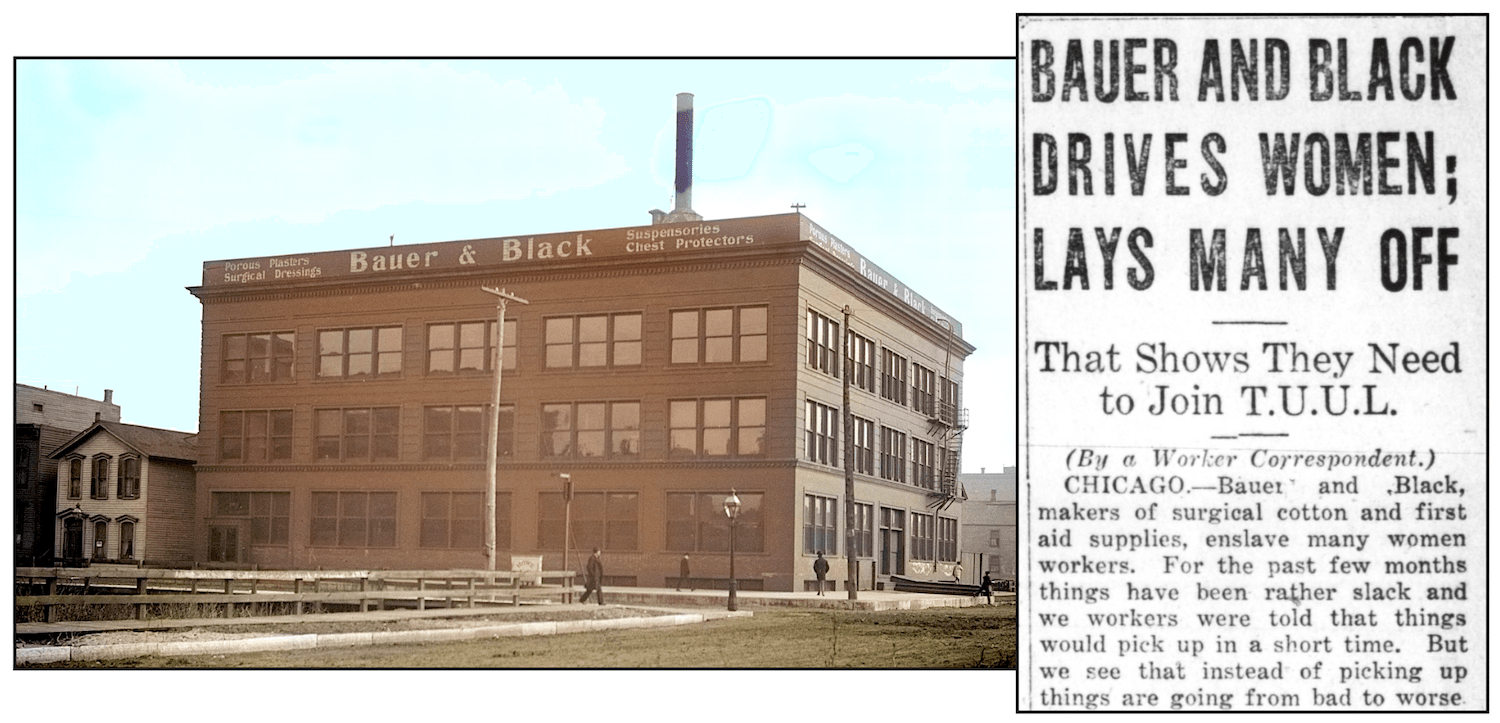
[Left: Bauer & Black factory, 45 W. 25th Street, in the 1910s. Right: Katherine Hyndman’s anonymous article published in the Daily Worker on March 8, 1930]
“And what are we to do about it? Organize into the Trade Union Unity League, for only thru organizing ourselves in a fighting organization that is all for the working class in all its daily struggles against the enemy, the capitalist class, can we workers win.”
Hyndman grabbed a half dozen copies of that issue of the Daily Worker, March 8, 1930, and cut out her article, posting it on various bulletin boards around the Bauer & Black factory. It caused, unsurprisingly, a sensation among her fellow workers.
“They thought it was the most magnificent, the most wonderful thing,” she said. “‘Hooray! Somebody cares about us. Listen, it’s in print. It’s in a newspaper!’”
The workers were ordered back to their stations, and at the end of the day, Katherine was asked to meet with the head of personnel, who told her, “We don’t think you’re happy here. And we think it’s best that we sever all connections. And here’s your pay.”
“And so that’s how I got fired,” Hyndman said.

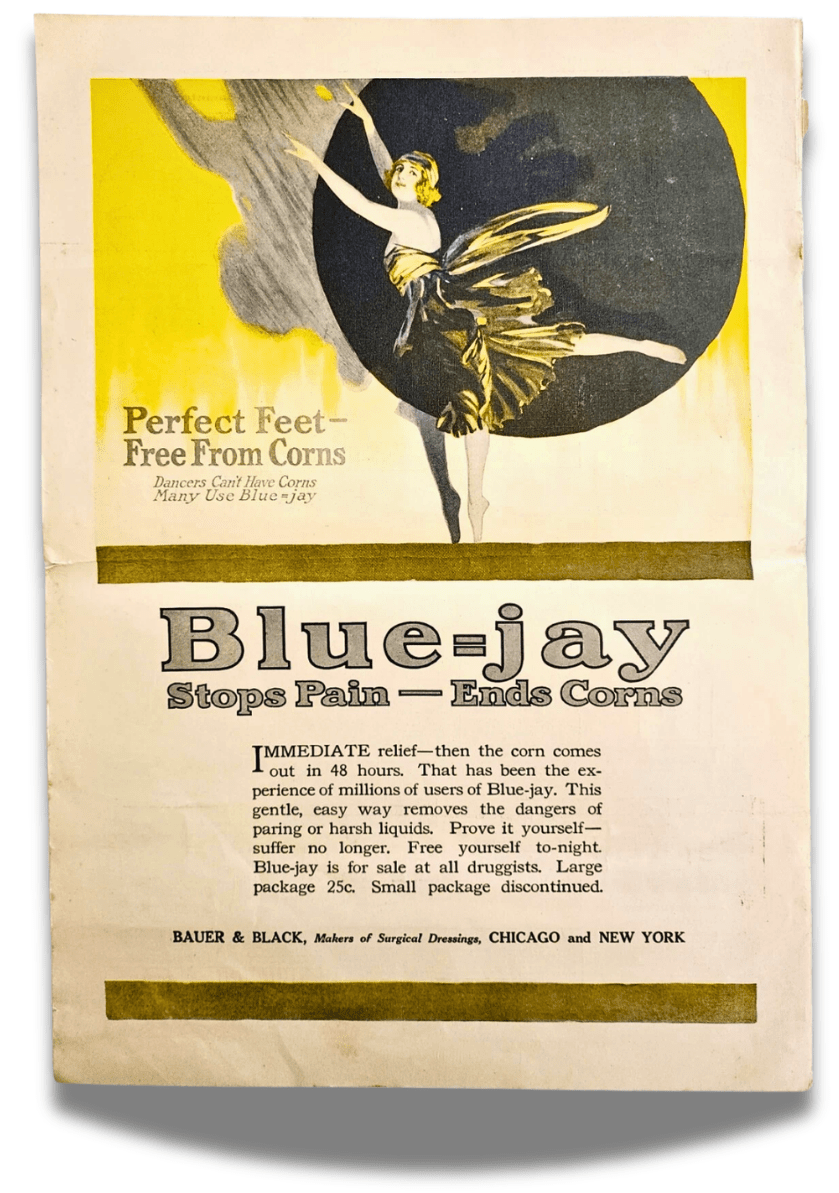
[1918 Blue Jay Corn Plaster advertisements]
History of Bauer & Black
While Katherine Hyndman’s experience at Bauer & Black became a textbook example of worker exploitation in the Great Depression, it had been a quite a different story in the years before the stock market crash, when the company was still owned by the families who founded it.
 “Bauer and Black was one of the nicest companies I have ever worked for really, at first I was quite happy there,” Hyndman said. “The wages were only 30 cents an hour, but they had an extra Christmas bonus. You got–how much was it? You got $50, I think, for the first year. I know that my last bonus was $200, which you got at Christmas time. We used to have a paternalistic kind of thing there. And it was clean, it was quite nice, and I made many friends there. . . . Their machines were in good shape. The stitches had to be small. Whatever product Bauer and Black made was first class. And it was produced putting out first class work. No second class ever went out at Bauer and Black.”
The original Bauers and Blacks in question were Stephen H. Black (1861-1916), Louis Bauer (1840-1909), and Bauer’s sons Alexander Bauer (1862-1944) and Gustav Bauer (1867-1927), first generation German-Americans. It seems as though Alexander Bauer teamed up with Stephen Black to launch the business in 1894, as a spin-off business of the established T.W. Heinemann Company, for which the Bauer boys had previously worked. Black had over a decade of experience himself in the field of “porous plaster and surgical dressing” manufacturing. The first company offices were at 36 W. Monroe Street, followed by 1245 State Street. By 1899, they’d started a lease on a new office building at the southeast corner of Armour Avenue and 25th Street.
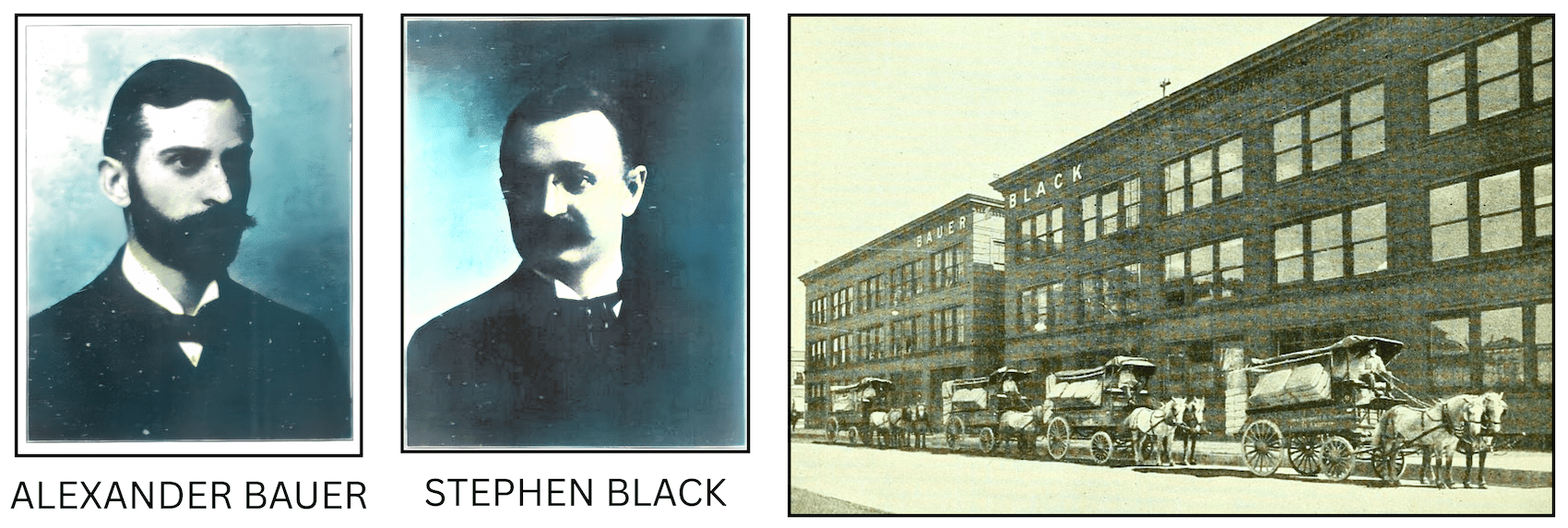
“Each department in the Bauer & Black business is under the personal supervision of a member of the firm,” the American Druggist and Pharmaceutical Record reported in 1899. “Nearly all their employes have been in the service of their predecessors and themselves from ten to twenty-five years and are thoroughly skilled in the various departments of their work. The result is a staple line of plasters, surgical dressings, suspensories and chest protectors, the quality of which is as nearly perfect as human skill, improved machinery and high-grade materials can produce. Through the successful efforts of a competent staff of twenty salesmen under the direction of Mr. Black, the Bauer & Black line has been thoroughly introduced throughout the United States, Canada and some foreign countries.”
The company opened up a New York office by 1901, and rolled out its famous “Blue Jay” product line around the same time, picking the striking bird as the official mascot for their full arrangement of plasters and corn and bunion treatments.
By the time of the Great War, Bauer & Black had a big enough operation that it became one of the key providers of absorbent cotton, bandages, and surgical gauze for the Red Cross, aiding injured soldiers on both sides of the conflict. Hundreds of massive crates full of this product left the company’s Chicago plant on horse-drawn carts, ultimately bound for ships in New York and battlefields in Europe.

[Top Left: 20,000 LBS of cotton bales in Bauer & Black’s Chicago warehouse, bound for the French Red Cross during World War I. Top Right: A group of Red Cross nurses from Chicago, traveling on a ship with Bauer & Black’s first aid supplies. Bottom Right: First aid supplies being loaded on to a wagon. Bottom Left: Bales getting loaded into chutes at the Chicago warehouse, down to awaiting wagons below.]
“The marked preference of the American Red Gross for Bauer & Black products is plain evidence of superior quality,” a company booklet read at the time. “And now foreign governments follow the choice of the United States, whose soldiers for years have been equipped with B & B First Aid Packets.”
Alexander Bauer was still running the company when he was courted by the execs at the Kendall Company in the late 1920s, and decided to sell the firm, taking a position on the Kendall board as a consolation prize. Bauer & Black was based at 2500 S. Dearborn Street by this point, and a teenage Kate Hyndman was among its employees.
 “When I first started at Bauer and Black I worked in the corn plaster department, and you put certain things on by hand, on the corn plasters,” Hyndman recalled, noting that the Kendall Company immediately moved in new machinery after their takeover to try and save on labor costs. “Well, shortly, they got machinery and the whole thing just went, you know, one-two-three. The machine just put out by the thousands instead of putting them on by hand, and so on. So I could see machinery taking the place of human beings and the people who didn’t have an education would be without work. So I became very, very much concerned.”
After Hyndman was fired in 1930, some of her former co-workers did rally behind her cause.
“A few years later one of the girls who had been my closest friend called me on the telephone and she said, ‘Katherine, guess what!’ I said, ‘What?’ She said, ‘I’m the picket captain at Bauer and Black.’ Some C.I.O. union came and organized them. And the girl who had been my closest girlfriend was the picket captain.”
The organized workforce helped improve things under Kendall’s control in the ‘30s, and Bauer & Black continued on as a Kendall subsidiary at the same Chicago location, 2500 South Dearborn, through World War II and beyond. Like the First World War, WWII demanded huge contributions of first aid products from Bauer & Black, and in an unexpected way, it became a peacetime selling point for the company in the years after.
“Because of wartime lessons learned,” our old pal C. K. Perkins wrote in another piece for Sales Management magazine in 1946, “the public is no longer satisfied with what is sometimes called ‘shirt-tail’ surgical dressing; the use of any loose scrap of cloth, unsterilized and often exposed to dust and air.” Instead, as Perkins happily tells his clients, professional-grade B&B products were now in their highest demand ever among the general populace. “It all spells business potential if the druggist is alive to his opportunities. The possibilities, compared to pre-war selling, are tremendous.”

An expansion of Bauer & Black’s Chicago HQ in 1946 enabled broader research and production of Blue Jay toiletries, Curity surgical dressings, Polykem industrial tapes, Curad brand bandages, and Bike athletic straps and protective gear. Sales were strong, and some employees felt good enough about the atmosphere in the plant to stay on for most of their lives, including Marie Bohenkamp, who joined the company in 1908 and celebrated her 50th year as a Bauer & Black girl in 1958 with a big banquet in her honor.
In 1972, B&B’s parent company, Kendall, was acquired by Colgate-Palmolive, and four years later, the Bauer & Black business was sold to Becton, Dickinson & Company out of New Jersey, after an earlier offer from Dr. Scholl’s fell through. Chicago production appears to have concluded around this time, and sightings of the good old Blue Jay brand diminished as bigger companies like Johnson & Johnson and 3M dominated the industry.
 Since 2009, 3M has owned the Bauer & Black brand name, which is now used pretty much only for a line of 3M’s “athletic supporter” and “suspensory” products.
As for Katherine Hyndman, the activist spirit never wavered, as she continued to protest injustices and ultimately got herself thrown in prison in 1952 for being part of an American Communist anti-war rally. She eventually left the Communist Party, as well, feeling it had been corrupted much like the capitalist businesses she’d worked for in her youth.
According to Hyndman’s nephew David, “Aunt Katie never lost her fierce passion for social justice. She was not ashamed about going to jail because she was convinced she was right and the government wrong.”

[The former Bauer & Black building at 2500 S. Dearborn, still standing in 2026]


Sources:
“Of the Firm of Bauer & Black” – American Druggist and Pharmaceutical Record, July 10, 1899
To the Front in Europe’s War – published by Bauer & Black, 1914
Stephen H. Black [obit] – Chicago Tribune, Jan 5, 1916
“Kendall Company Will Buy Out Bauer & Black” – The Rubber Age, Sept 25, 1928
“Bauer and Black Drives Women, Lays Many Off” – The Daily Worker, March 8, 1930
“A Modernized Sales Plan Ushers in a New Era for Bauer & Black” – Sales Management, April 26, 1930
“Bauer & Black Campaign Rides Tides of Wartime Interest in First Aid” – Sales Management, March 15, 1946
Katherine Hyndman Interview by Straughton Lynd, Roosevelt University, 1970
Union Maids [film] – 1976
I have a First-Aid Packet made by Bauer&Black of Chicago with the inscription;
CONTRACT Aug.12,1916
It is in intact except for damage to the bottom which appears to be the result of a bullet or a piece of shrapnel.
Looking for some suggestions as to how to find a interested party